



6th March at 2 p.m. Miklos (Miki) Ambrozy, a doctoral student in Fine Arts, will defend art project „Degrowing Poetics“ (Fine Arts V 002) at cinema and media space „Planeta“ „Meno avilys“ (A. Goštauto Str. 2, Vilnius).
The dissertation defence meeting will be held in English.
Art project supervision:
Assoc. Prof. Dr. Gabrielė Labanauskaitė (2023-2025)(Lithuanian Academy of Music and Theatre, Performing and Screen Arts, Theatre and Film C 002, Humanities, Art History and Theory H 003),
Prof. Deimantas Narkevičius (2021-2023)(Vilnius Academy of Arts, Visual Arts, Fine Arts V 002).
Thesis supervision:
Prof. Dr. Vytautas Michelkevičius (Vilnius Academy of Arts, Visual Arts, Fine Arts V 002; Humanities, Art History and Theory H 003; Social Sciences, Communication and Information S 008).
The Artistic Research Project will be defended at a public meeting of the Academic Board of Fine Arts at Vilnius Academy of Arts composed of the following members:
Chairperson:
Assoc. Prof. Dr. Julijonas Urbonas (Vilnius Academy of Arts, Visual Arts, Fine Arts V 002)
Members:
Assoc. Prof. Dr. Lina Kaminskaitė-Jančorienė (Lithuanian Academy of Music and Theatre, Humanities, Art History and Theory H 003)
Dr. Anouk de Clercq (School of Arts University College Ghent (Belgium), Visual Arts, Fine Arts V 002)
Prof. Dr. Agnė Narušytė (Vilnius Academy of Arts, Humanities, Art History and Theory H 003)
Dr. Vincent Roumagnac (University of the Arts of Helsinki (Finland), Performing and Screen Arts, Theatre and Film C 002, Visual Arts, Fine Arts V 002)
Abstract
Degrowing poetics is an unmaking of dominant ideas about making. A film that disappears, like a bonfire, once we have seen it. Words that degrow into the compost in our farmstead, becoming humus for our chokeberries.
Degrowing Poetics raises questions for thinking with ecology and the poetics of analogue imaging. As a doctoral project, my work been shaped by the slow erosion of ideas, research questions, and artworks on a journey of impermanence. Through a method of mo(u)lding, I combine creative writing, photochemical experimental film, and crafting a “living” theory. The connecting tissue is a turn towards the ecological. By collaborating with the field of microbiology, I developed a worlding-view that I call “poeisis from the milieu of practice”—a fertile encounter between philosophy, art, biology, and indigenous research.
Degrowing poetics is an organically occurring, cyclical process of balancing and weathering. It resulted in various artworks, tools, a glossary, a protocol of care, and a proposition for a model of doing research. In the contemporary context of film art and photography, I use a “spiral model” to critically investigates assumptions around what growth—and the accumulation of images, things, worlds, beliefs, anxieties—entails. I focus on forms of poiesis that include more than ideas in human minds or language—forms that aspire to incorporate multiple relations in the world.
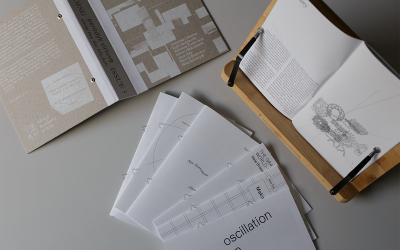
Throughout the artist’s book Degrowing Poetics — [_] {}(o), I argue that contemporary analogue film practice affords critical complexity for ideas to emerge from its sites and landscapes. These places and thoughts can in turn affect larger ethical and practical questions of artists doing research, and the assumptions that underpin such production.
__________
M. Ambrózy and R. Hazekamp, 17 October, 17:32 , 2025, digital phorograph, Vilnius.