
Goda Verikaitė
Materialities in Flux: Architectural Stories from Vilnius and Rotterdam
Keywords: materiality, architecture, landscape, agency, cycle, regeneration, speculative storytelling
Landscape – ... – architecture – ... – landscape
What words would you write between these punctuation marks? How many geological and symbiotic processes, utopian promises, repositories of memory, and extractive material transitions linger within this “in-between”, before the landscape turns into architecture and architecture turns into landscape?
Architecture is often perceived not as a process, but rather as the result of a linear progression. By employing various theories of material culture, this art project explores the relationship between landscape and architecture as a constantly evolving entity. This research aims to shift the dominating view of matter in architectural discourse, perceiving it not as a silent and passive raw material, but as a living element that interacts with and acts upon its political, cultural, and ecological contexts.
The idea for this project emerges from two places connected to the author’s personal experience of living and practicing between Lithuania and the Netherlands. At first glance, these locations do not have anything in common. Yet, by delving into their stories of origin, they begin to weave into an unexpected dialogue through their material biographies. The chosen cases are the Lazdynai mass housing district in Vilnius and Hoge Bergse Bos Park in Rotterdam, both formed in the second half of the 20th century as the physical manifestation of the prevailing ideologies. Gravel excavated from the Gariūnai quarry was used for the construction of Lazdynai. Meanwhile, the hilly terrain of Hoge Bergse Bos was artificially created from the rubble and reconstruction debris of Rotterdam after World War II.
This parallel encourages seeing architecture not as a static structure, but as a cyclical system. From this perspective, a standing building is not a fixed object, but just a moment in time—an agential entity that is “always in the making, even when it begins to decay or is actively destroyed,”[1] through its constant intra-action with other actors in the environment. This research asks: how can the processes of landscape–architecture transition be rewritten through artistic means into regenerative scenarios, fostering material awareness and stimulating the imagination for spatial practices?
The term regeneration in architecture discipline derives from biology. A salamander can regrow a lost limb, just as a human rib heals on its own after a fracture. If we see a building as a living entity or an intermediate state of the landscape, what new forms of regeneration might it generate? This research adopts artistic methods to seek radical expressions and metaphors of material regeneration. It employs both empirical field research, archival investigation, interviews, site documentation, and walks through the researched landscapes, as well as speculative tools of the imagination. Experiments with traditional architectural formats, such as models, dioramas, material prototypes, and cartographies, intertwine with textual and video stories. In this way, the project is grown as a multilayered and pulsating meshwork.
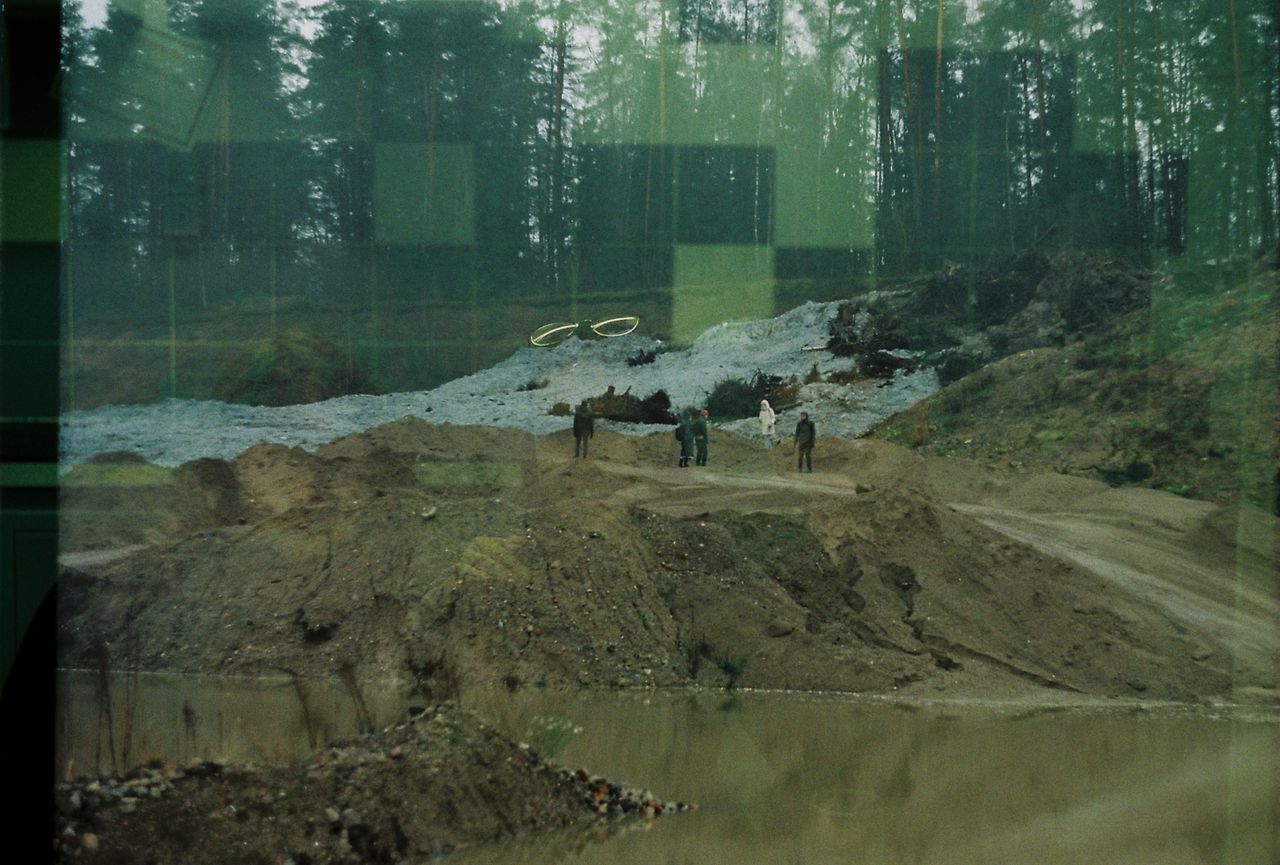
Walk in Gariūnai quarry. Photo: D. Ratkutė
__________
[1] Buchli, V. (2016), An Archaeology of the Immaterial. Routledge.