


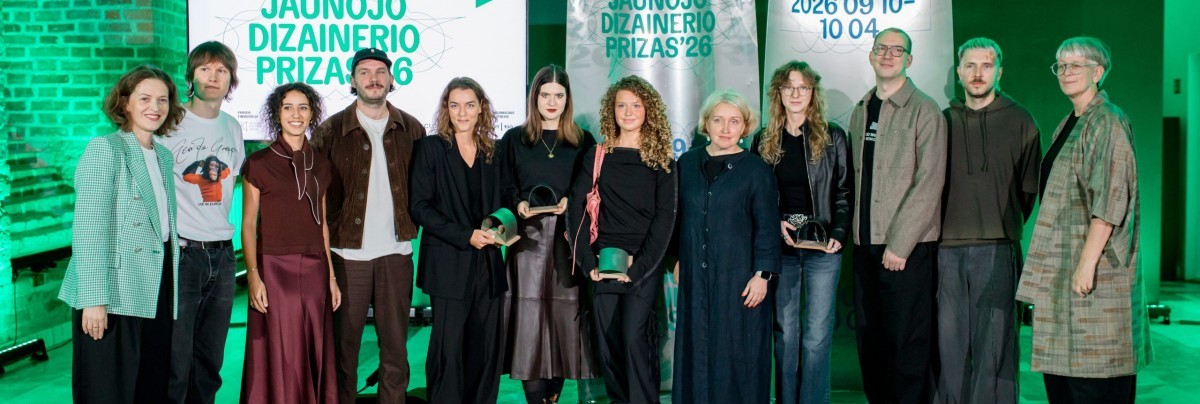


On the evening of September 10, the winners of the Young Designer Prize 2026 were announced at the Museum of Applied Arts and Design of the Lithuanian National Museum of Art (LNDM). During the awards ceremony, laureates in five categories were recognised, and an exhibition of the competition’s best projects was opened in the museum’s spaces.
Organised for the sixteenth time by the Design Innovation Centre of the Vilnius Academy of Arts, this year’s competition received 91 applications from five higher education institutions in Lithuania and abroad. Graduates of design programmes competed in five categories: Product Design, Communication Design, Fashion Design, Interior Design, and Design Research.
The submitted projects were evaluated by an international jury of design experts: Willem van Hooff (the Netherlands), Antonio Lo Presti (Italy), Francesca Pedroni (Italy), Linda Lissola (Sweden), Giulia Procaccini (Italy), Miro Sabo (Slovakia), and Pärtel Vurma (Estonia).
The evaluation process consisted of two stages. During the first stage, the jury selected 15 outstanding projects – three in each category. All 15 nominated projects are on display at the Museum of Applied Arts and Design (Arsenalo St. 3A, Vilnius) until October 4.
In the second stage, the jury met with the participants in person and selected the winner in each category. The winners received €1,500 cash prizes as well as gifts from the competition’s sponsors, Fiskars Group and Jung. Nominees in the Fashion Design category also received one-year licences for the digital fashion design and 3D garment simulation software CLO3D.
As is tradition, the competition also featured a People’s Choice Award, with the public invited to vote for their favourite project on the LRT.lt news portal.
Meet the 2026 Winners
People’s Choice Award and Interior Design Category Winner
Patricija Vaisova
Sound as a Tool for Creating Space: The Case of a Corridor
Vilnius Academy of Arts
Supervisor: Assoc. Prof. Dr Karolina Jašinskaitė
The project explores sound as a design tool capable of transforming the experience of a corridor space. The case study is the corridor of the Interior Design Department at the Vilnius Academy of Arts – a long, narrow and acoustically active transitional space.
The final outcome is a temporary interactive sound platform that uses microphones to capture footsteps, pressure-induced vibrations and movement, processes them in real time, and returns them to the space as an altered sonic response. Echo, delay and repetition transform the perception of distance, boundaries and orientation. Being and acting become the central elements of experiencing the space.
.jpeg)
Fashion Design Category Winner
Jomilė Uksaitė
Fashion Collection “Tolimė”
Vilnius Academy of Arts
Supervisor: Assoc. Prof. Dainius Bendikas
“Tolimė” is an experimental fashion design collection reflecting on human adaptation in the face of emotional detachment and the gradual loss of empathy.
The idea emerged from personal observations of growing up surrounded by technology: the light of screens increasingly replaced direct human gaze, while devices designed to bring us closer began to create emotional distance. In the collection, this paradox becomes a psychological ascent through six looks – from withdrawal and fog to vulnerability and shared shelter.
Fluid, body-enveloping silhouettes, handcrafted textures, natural fibres, felt footwear and mountaineering details become physical expressions of inner emotional states. In this work, adaptation does not mean withdrawal, but rather an attempt to preserve sensitivity, empathy and genuine human connection.
.jpeg)
Product Design Category Winner
Eva Zaveckaitė
From Personal Experience to Democratic Design: Furniture for Life on the Road
Vilnius Academy of Arts
Supervisor: Assoc. Prof. Barbora Adamonytė-Keidūnė
“Car[d]board” is a temporary seasonal travel furniture system made from honeycomb cardboard and designed for L1H1-type vans. As most van furniture is designed for specific vehicle models, the project seeks a more universal solution by comparing five commonly used vans in Europe and determining their average dimensions.
The lightweight, flat-pack structure can be installed, removed and operated by a single person. The system provides a 1500 × 2105 mm sleeping area and approximately 370 litres of storage space. The honeycomb cardboard used in the project consists of manufacturing offcuts and defective sheets, while the dry, glue-free assembly allows the cardboard to be recycled afterwards.
.jpeg)
Communication Design Category Winner
Kamilė Ražanskaitė
Computer Game “Prieš klasę”
Vilnius Academy of Arts
Supervisor: Assoc. Prof. Marius Žalneravičius
“Prieš klasę” is a visual novel exploring the theme of internalised shame. Designed for teenagers, the game encourages reflection and conversation about shame, ways of overcoming it, and how unresolved feelings of shame can become internalised and lead to difficulties over time.
The player’s decisions about how to respond to shame-inducing situations determine the ending of the game: will the protagonist, despite experiencing difficult emotions, pursue their dreams, or will shame prevail and become an inseparable part of their personality?
.png)
Design Research Category Winner
Domantas Pigulevičius
Speculative Project “Palaimoje”
Vilnius Academy of Arts
Supervisor: Assoc. Prof. Marius Žalneravičius
The project “Palaimoje” explores Lithuania’s allotment gardens as a speculative space of the future. This historical phenomenon, which once embodied the contradictions of Soviet occupation policies, continues to reflect the contemporary social context, albeit under different circumstances.
Because of its ability to reflect the state of society and its speculative potential, the phenomenon of allotment gardens is projected into the future and becomes a witness to a hypothetical world. The project tells the story of a fictional gardening community called “Palaima” and one of its residents, Vilius Kukoras, whose fate encodes the condition of this future world.
.jpeg)
More information about the competition: www.jdp.lt
Photos: Jorigė Kuzmaitė
Competition and exhibition organiser: Design Innovation Centre, Vilnius Academy of Arts
Competition funded by: Lithuanian Council for Culture
Exhibition architecture: Vytautas Gečas and Emilija Kazakevičiūtė
Graphic design: Ugnė Balčiūnaitė
Curator: Daina Eičaitė
Partners: Museum of Applied Arts and Design of the Lithuanian National Museum of Art, State Patent Bureau of the Republic of Lithuania, European Union Intellectual Property Office, intelektine.lt
Sponsors: Nordcurrent, Jung, Fiskars Group, CLO, Sip Sap, Dūmų fabrikas
Information partner: LRT